Ocean Campus becomes mass vaccine site on January 21, but no drop-ins allowed yet. Vaccines still by appointment only.
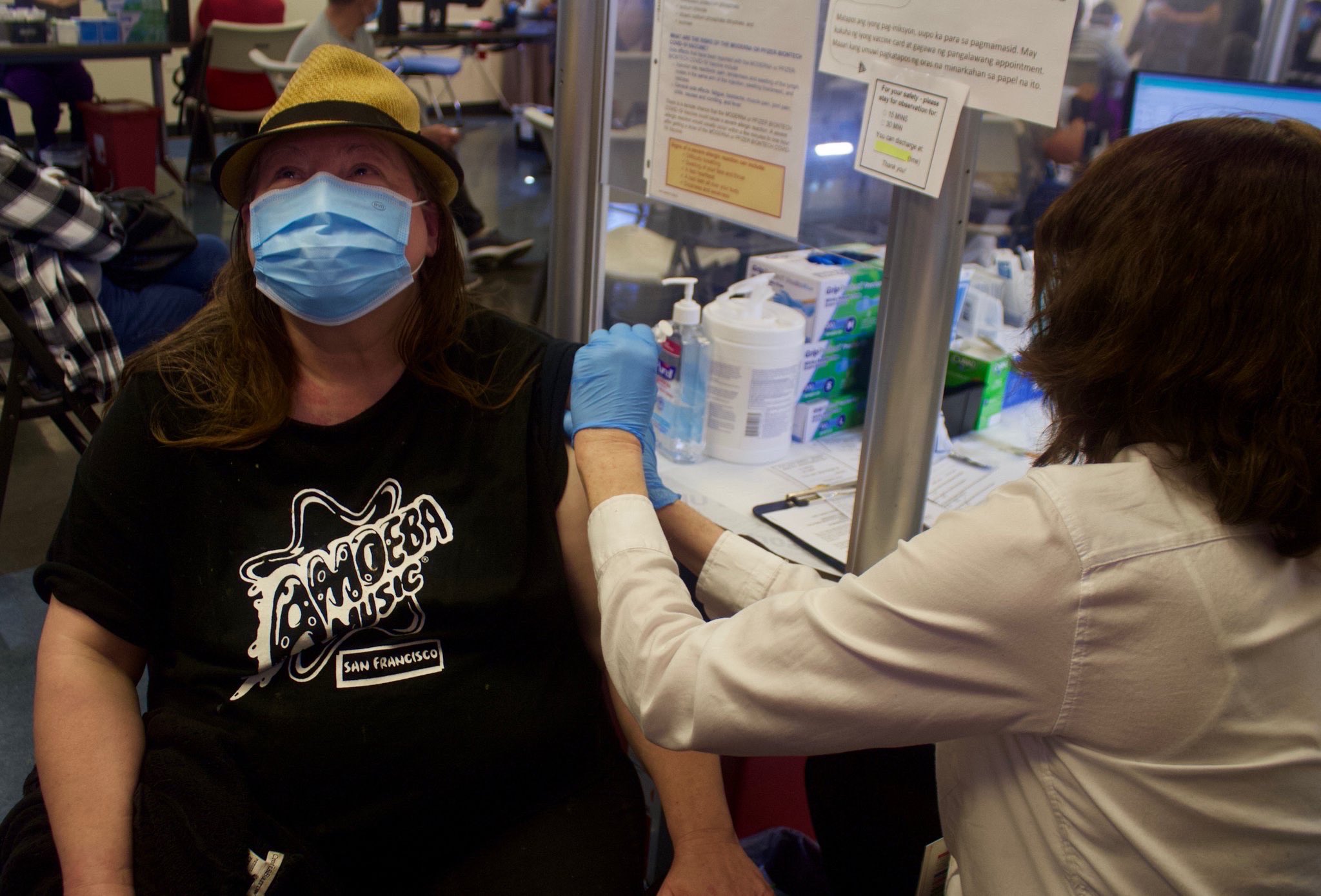
San Francisco’s Department of Health and Supervisor Matt Haney announced that San Francisco’s first “mass” vaccine distribution site will be opening on Friday, January 21, 2021 at CCSF’s Ocean Campus on Frida Kahlo Way in partnership with UCSF, Dignity Health and One Medical.
Please note that due to extremely limited vaccine supply there are currently no drop-in appointments at this site. All vaccines are going to those in the current priority group (health workers and those 65 and over) have already been spoken for and the site is by appointment only.
As more vaccine becomes available, SF’s healthcare providers & SFDPH will increase capacity at the City College site and open additional high volume vaccine sites.
Vaccines will also be available at community clinics, pharmacies, pop-up vaccination sites, and mobile sites as vaccine supply increases.
CCSF is the first of three planned “mass” vaccination sites in San Francisco. Moscone Center in SoMa and the San Francisco Wholesale Produce Market in Bayview are also planned, but not opening date has been set yet.
So far (as of January 19, the most recent data date) 31,189 San Francisco residents have received their first dose of the vaccine. That comes out to about 3.6% of the city’s population.
How many people who live in San Francisco have received at least one dose of a coronavirus vaccine?
The dashboard below shows the number of people who live in San Francisco who have received at least one dose of the coronavirus vaccine, regardless of where they received their vaccinations. People who work in San Francisco, but do not live in San Francisco, are not included.
The information at the top of the dashboard reports the number of people who live in San Francisco who have received at least one dose of the coronavirus vaccine and the total number who have received a second dose. Additionally, it reports on the percent of the San Francisco population that has received at least one dose and that has received a second dose.
Tickets now on sale for Fort Mason Flix’s February screenings
Fort Mason Flix is a pop-up drive-in theater on the waterfront showing hit movies six days a week, from family favorites and cult classics to blockbusters and art house cinema.
The theater features an oversized 40’ x 20’ high definition LED Screen. At 4,500 nits, this powerhouse screen is up to 90x brighter than a standard movie theater projector, allowing visitors to enjoy their favorite movie in daylight as well as after sunset.
Fort Mason Flix February 2021 Fort Mason Center for Arts & Culture, 2 Marina Boulevard, San Francisco > Buy Tickets: $49 per vehicle – limited to legal capacity of car based on number of seatbelts.
The first batch of September movies sold out in three days, so buy quickly if you want to attend.
Bay Area’s MLB, NFL and NHL teams have offered up their stadiums and arenas to potentially become mass vaccination sites
California is expanding its vaccination efforts, and Bay Area teams including the A’s, Giants, 49ers and Sharks have proposed the possibility that their stadiums become mass vaccination centers.
San Francisco Chronicle noted that the A’s and 49ers’ stadiums have large parking lots which could work well to handle a large turnout. The A’s have been in conversations with state and local officials to transform their parking lot at the Coliseum into a drive-through vaccination site.
Also, the 49ers’ team President Al Guido has also offered Levi’s Stadium as a vaccination site in a letter to the Santa Clara County Board of Supervisors. His letter notes, “In collaboration with our partners, Levi’s Stadium offers a facility with the requisite technology to store vaccines, world-class security, and the capability to partner with public health professionals to administer vaccines.”
The Giants, as well, has offered to make its “ballpark facilities available in whatever way is needed” to help with the vaccination efforts. The Sharks joins fellow Bay Area teams in offering up the SAP Center as vaccine site.
Our stadiums would join Dodger Stadium in Los Angeles and Petco Park in San Diego which have already been approved for mass vaccination centers and are slated to open as early as next week. The hope is that these sites will help speed up California’s vaccination rate.
NHL finally released a rendering of the new ice rink on the 18th hole at the Edgewood Tahoe Resort golf course in Lake Tahoe.
The League announced the two-game series, NHL Outdoors at Lake Tahoe, which will feature two regular-season games against the backdrop of the beautiful Sierra Nevada mountains.
Although there will be no fans present, the opportunity to play without a crowd led the league to choose a unique setting that wouldn’t otherwise be possible.
The game won’t be played actually on the lake, but on a regulation rink that will be built on the 18th fairway on the shoreline. They’ll even be locker rooms that feel like wooden cabins and a retro scoreboard.
On Saturday, February 20, Colorado Avalanche and Vegas Golden Knights will face off, and on Sunday, February 21, the Boston Bruins and Philadelphia Flyers will take the ice.
The three-week “Stay at Home” order that was triggered for the Bay Area on December 18 after ICU capacity for the region fell below 15% was originally supposed to be revisited starting January 8th, but there has been no official word from the State of California.
A region is supposed to be able to exit the stay at home order when a 4-week projection is above or equal to 15%. To our knowledge, the state has not shared any of these projections, or exact methodology as to how these projections are made.
Number of ICU Beds Currently “Available” in Bay Area as of 1/6/21 – see data source
Bay Area Total – 267 (lowest number since at least March)
Alameda – 69
Contra Costa – 27
Marin – 14
Monterey – 33
Napa – 3
San Francisco – 46
San Mateo – 12
Santa Clara – 27
Santa Cruz – 4
Solano – 8
Sonoma – 24
Why a Drop in Available ICU Beds Doesn’t Always Mean More Hospitalizations In general, it’s safe to assume that a drop in available ICU beds correlates with more more ICU beds being occupied, but not always. Please note that maximum number of potential ICU beds on a per region or county basis is not shared by the state of California and that potential ICU bed numbers can change depending on staffing and the ability to convert “normal” beds into ICU beds which is a common practice when overflow is needed. So without the state providing more detailed statistics and data on what it considers an “available” bed to be, in some cases it’s unclear if a drop in the number ICU beds available is the result of more hospitalizations, temporary ICU beds being converted back into regular beds and taken “offline,” or a combination of both.
In addition the Bay Area has 375 potential hospital beds not included in the above numbers that are considered “warm” and ready to be activated quickly in case of an emergency surge (125 in San Francisco in The Presidio and 250 in Richmond at the Craneway Pavilion)
When is a Regional “Stay at Home” Order Supposed to End? Here’s what the state of California says are the criteria for determining when a region can exit the stay-at-home order, but to our knowledge the state has not provided any specific stats or backup to determine the numbers below or to understand exactly how the projections are made.
After three weeks from the start of the Regional Stay Home Order in the region, one of two situations would occur:
The order will end in a region if the region’s ICU capacity projected out four weeks (from day 22 after the Regional Stay Home Order started in the region) is above or equal to 15%. Each county in the region will then be assigned to a tier based on the Blueprint for a Safer Economy and the rules of the Blueprint will apply again.
The order will remain in effect in a region if its ICU capacity projected out four weeks (from day 22 after the Regional Stay Home Order started in the region) is less than 15%. The order will remain in effect until the region’s projected ICU capacity is equal or greater than 15%. This would be assessed approximately twice a week.
According to the state of California’s COVID dashboard, as of 1/5/21 the Bay Area has ICU availability of 3.5%, but the state has not provided actual data backup for exactly how this number is calculated or the exact county-by-county breakdown, or the total number of ICU beds a county is considered having which can change daily depending on staffing and the ability to convert normal beds into ICU beds.
As of 1/5/21 San Francisco reports its ICU capacity 33%.
Delivery of shiny new “Fleet of the Future” trains on hold for at least 12 weeks while BART works out software & wheel issues.
Thanks to the Mercury News for letting us know that BART has paused their delivery of new “Fleet of the Future” trains due to software glitches and reliability issues putting it’s $2.6 billion effort to swap out a decades-old fleet of trains on hold.
Thanks to glitches in the on-board automatic train control system, the “new” cars routinely stop while in service and can’t move again until the train operator reboots the systems. This results in a 5-10 minute delay.
As of January 8, 2021, BART is expected to have 290 “Fleet of the Future” trains in service and 618 “legacy” cars.
Additionally, in wet weather the train’s wheels can develop “flat” spots when stopping, so the cars need to be removed from service so that the wheels can be resurfaced.
The pause in delivery of new trains will begin on January 8 and is expected to last at least 12 weeks.
This doesn’t appear to have any impact on the number of trains in service, only that older “legacy” cars will be decommissioned at a slower rate.
BART will temporarily stop accepting delivery of new Fleet of the Future (FOTF) rail cars beginning January 8, 2021 to allow the manufacturer, Bombardier Transportation, the time to take steps to improve the cars’ reliability and availability, and to alleviate rail car storage constraints at BART’s maintenance yards.
One of the issues to be resolved is related to software in the on-board automatic train control system. The new cars routinely stop while in service and will not move until after the Train Operator reboots the system, resulting in a five-to-ten-minute delay.
In addition, when trains are stopping under wet or rainy conditions, the cars’ wheels can develop flat spots. When this occurs, the cars need to be removed from service so that the wheels can be resurfaced.
While neither issue impacts the safety of existing FOTF cars currently in service, they can impact service reliability and car availability.
BART is expected to have 290 FOTF cars by January 8th and, combined with 618 legacy cars, BART will be required to retire legacy cars to create room for additional FOTF cars. Given the pause in delivery of new cars, which is expected to last a minimum of twelve weeks, BART will decommission legacy cars at a slower rate.
BART is committed to supporting Bombardier Transportation as they work to address issues that impact the reliability and availability of the FOTF, and to implement pragmatic solutions that will provide the highest levels of performance for the new cars.
SAN FRANCISCO, Calif. (BCN) – City officials on Saturday reminded residents that San Francisco’s curbside pickup of holiday trees will take place in early January.
Last year, the city chipped more than 500 tons of Christmas trees into mulch.
“Not only does this ensure that discarded holiday trees will be put to good use as earth-friendly mulch, but disposing of them properly also helps keep our neighborhoods clean and safe and reduces fire hazards,” said Acting Public Works Director Alaric Degrafinried.
After removing tinsel, decorations, nails, plastic bags, stands, and lights from the trees, residents can place them next to blue recycling bins the night before their scheduled collection day, between Jan. 4 and Jan. 15.
Any tree more than 6 feet tall should be cut it in half. Trees should not be put into plastic bags.
The trees will be chipped in San Francisco and turned into mulch at a Recology composting facility.
The holiday collection schedule is available on www.Recology.com.
For more information, email Recology at CustomerServiceRecologySF.com or call the company at (415) 330-1300.
Every evening at sunset, over 220 state-of-the-art LED lighting fixtures illuminate City Hall’s exterior. Normally, a soft white glow shows off the play of light and shadow on the full façade and dome. Frequently, special plaza façade lighting schemes honor or celebrate events, seasons, and holidays.
City Hall will be lit up in green and red most nights in the lead up to Christmas and immediately afterward.