Zero Waste at Madrone

Dear Residents,
Thank you all for being attentive about recycling and participating in an effort to reach zero-waste within our community.
As a refresher, below are some handy tips:


Thank you all!

Dear Residents,
Thank you all for being attentive about recycling and participating in an effort to reach zero-waste within our community.
As a refresher, below are some handy tips:
Thank you all!
Lift your spirits with dazzling lights as The Bay Area shines for the holidays!

Winter is coming. The holidays are just around the corner and we all could use a little extra holiday cheer to lift our spirits and start looking forward to the new year (and the end of 2020).
While big tree lighting events and holiday festivals are mostly cancelled for this year or have gone virtual, you can still find plenty of twinkling holiday lights around The Bay to help you get into the holiday spirit.
Nov. 18 – Dec. 31, 2020
Westfield Centre, 865 Market St., Level 4 Under the Dome, SF
FREE
San Francisco’s famous Inverted Christmas Tree, the 50-foot chandelier-like tree, covered in crystals, is back for the holidays under the iconic Emporium Dome.

Winter Wonderland Holiday Market: Friday, November 27, 2020 | 12 – 6 pm
Christmas Tree Stroll: November 27 through the holiday season
Ghirardelli Square, San Francisco
FREE
New for 2020 – Pickup some gifts at the festive holiday market, and then take a self-guided Christmas Tree Stroll to see beautiful trees decorated by the talented students at the Academy of Art, up throughout the holiday season. *Please note, we haven’t confirmed if they’ll be lit, but what kind of Christmas tree doesn’t have lights? The square will also be decked out in holiday lights, starting on 11/27.
New for 2020 – The iconic 19-foot-tall, 152-foot-wide “Ghirardelli Square” sign recently returned to the square after a refresh with newly installed LED lighting that will allow for special colors whenever needed for the holidays or for special events or honors. We hope this means the sign will illuminate red and green for Christmas, and blue and white for Hanukkah.
December 10, 2020 to February 28, 2021 | Sundown to 10pm
Possible extension to June 1, 2021
Peacock Meadow (between McLaren Lodge & Conservatory of Flowers)
Golden Gate Park, San Francisco
FREE
New for 2020 – A whimsical wonderland of 20-foot tall lighted trees will shine to honor the park’s 150th anniversary. It’s an immersive light experience where visitors can explore paths and sit under a grove of entwined sculptural trees

Week of December 6-12, 2020 – January 31, 2021
The Exchange on Sixteenth (SoMA)
1800 Owens St., San Francisco, CA
FREE
New for 2020 – The Kilroy Star’s 30,000 sparkling LED lights will illuminate the SF skyline and can be seen from miles away. The dazzling lights will configured to oscillate in various rhythms and patterns.
Dear Residents,
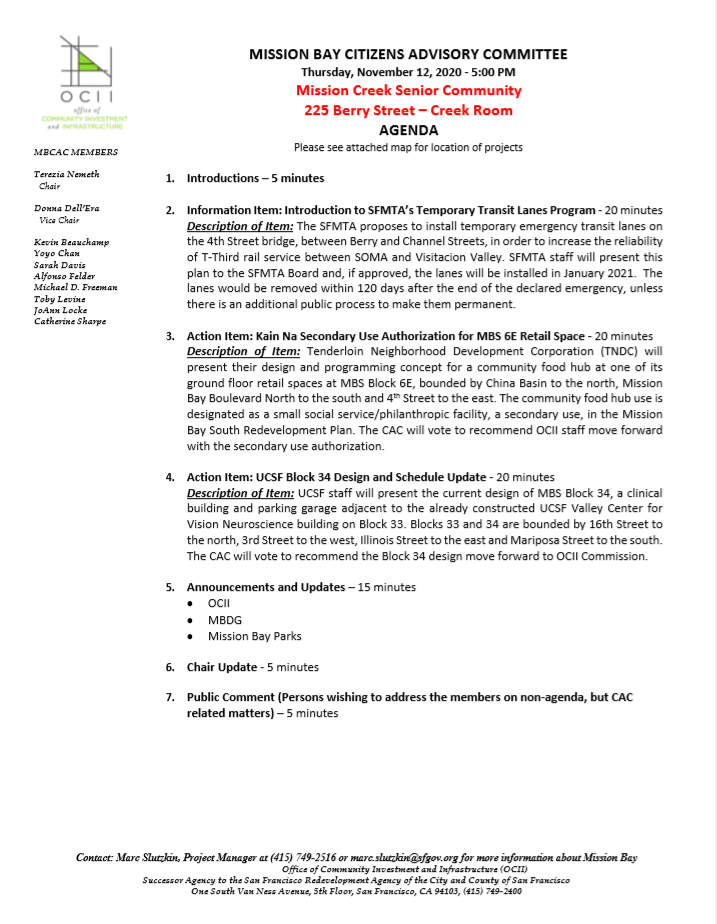
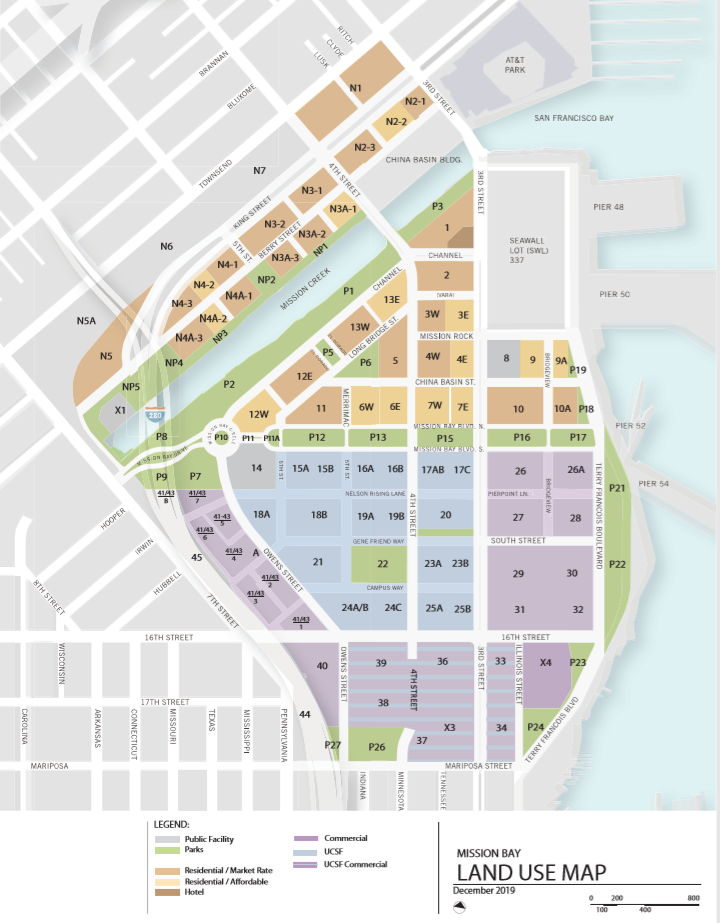
The Mission Bay Office of Community Investment and Infrastructure is holding a virtual Mission Bay Citizens’ Advisory Committee meeting on Thursday, November 12, 2020 at 5:00 pm. Please find below, the instructions for attending the virtual meeting, the agenda items on page 2, and a land use map for reference on page 3. The highlighted portions of page 1 include links to access the meeting.
Meeting materials will be available for download on the day of the meeting at https://sfocii.org/mission-bay<https://protect-us.mimecast.com/s/K8ZICER12gIWXPAwfNUxwj>.